




Media Library

Documentary, graphic and/or audiovisual knowledge objects are offered here, offering information on various sectors and topics. Use the keyword search or search filters to access current audiovisual and documentary knowledge objects useful for your implementation.

If you have any questions or suggestions, please contact us here.

Contingency Plan for Golden Flavescence of the grapevine

This document sets out the measures to be taken against Flavescence dorée of grapevine (FD), a Union quarantine pest regulated by Regulation (EU) 2016/2031 and Regulation (EU) 2019/2072, with the aim of preventing its appearance, and, if it does appear, acting quickly and effectively, determining its distribution and combating it in order to prevent its spread and eradicate it.

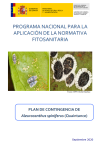
Aleurocanthus spiniferus Contingency Plan (Quaintance)

This document sets out the measures to be taken against the quarantine pest Aleurocanthus spiniferus (Quaintance), with the aim of preventing its appearance and, if it does appear, acting quickly and effectively, determining its distribution and combating it in order to try to eradicate it and prevent its spread at all times.

Phytosanitary bulletin of notices and information

Pollinating insects are vitally important for the proper functioning of crops. Pollination is essential to ensuring the quantity and quality of crops and food production, directly linking wild ecosystems with agricultural production systems.

Webinar - How does digitalization impact pest and disease control in greenhouse crops?

How does digitalization impact pest and disease control in greenhouse crops?

INFOVI: Market Information System for the Wine Sector

Behind every bottle of wine there is much more than grapes and vineyards. Tradition, effort, and constant work sustain the wine sector. Today, thanks to the INFOVI system, Spanish wine has greater transparency and real-time data to make better decisions.

Regenerative Viticulture

Importance of microbiology in agricultural soils

Wine sector intervention

Wine sector intervention, Interventions within the framework of the CAP Strategic Plan

Microbiological techniques to address climate change in the wine industry

Over the last few decades, it has become clear that wines from current and future harvests will undergo chemical and microbiological alterations due to the effects of climate change. Changes in grape ripening are producing musts with higher sugar concentrations and lower acidity, resulting in wines with higher alcohol levels and less freshness on the palate.

Feasibility study on the use of ATR-FTIR spectroscopy as a tool for estimating polysaccharides in wine

Polysaccharides are the main colloidal macromolecules present in wine. These compounds play a fundamental role in stabilizing other molecules in solution, thus modifying the wine's processing and organoleptic properties. Various analytical techniques have been proposed for their determination. However, most are complex and time-consuming.

Oenological suitability of native yeast strains for the production of 'Verdejo' wine

The use of indigenous yeasts in wine production is a tool for preserving the typicity of a particular region. Selecting appropriate indigenous yeasts ensures the maintenance of oenological characteristics by simulating spontaneous alcoholic fermentation (SF) while avoiding the risks of stalled or slow fermentations.

Selection and use of wild strains of Lachancea thermotolerans from the Rioja DOC with bioacidifying capacity as a strategy to mitigate the effects of climate change in the wine industry

Wine is an alcoholic product that has been produced worldwide for millennia with very few changes to its production process until the last century. Over the past few decades, grapevines have been affected by climate change as multiple climacteric crops, and consequently, the composition of grape must and the final wine is changing.

Impact of the harvest season on the biodiversity of wild yeasts and their influence on wine fermentation

The grape microbiome is a key factor impacting the composition and aroma of wine.

Characterization of the impact of different clarifying agents on white wine colloids by Asymmetric Flow Fractionation in the Field

Clarifying agents are substances used during the winemaking process to improve the clarity and stability of wines. Different clarifying agents can alter the removal capacity in different ways.

Clonal selection of grapevine cultivars from the Principality of Asturias

Asturian vineyards are part of the mountain viticulture tradition. The vines are characterized by their age, their location on steep slopes, and their diversity and exclusivity of grape varieties.

Study of pruning types and planting frames in grape varieties of Asturias

Asturian vineyards are situated on steep slopes and are characterized by their age, varietal diversity, lack of mechanization, and high planting densities. In recent years, this crop has been expanding, with new plantings being established on terraces and at lower densities to allow for mechanization.

Rootstock trial in grape varieties from Asturias

In antiquity, the Greek geographer and historian Strabo (c. 63 BC – 20 AD) mentions that the pre-Roman inhabitants of Asturias knew about wine, but it was very scarce and they only drank it at large feasts.

Dossier of supra-autonomous innovation projects

Inventory of innovative projects implemented by supra-regional operational groups of the European Innovation Partnership for agricultural productivity and sustainability of the National Rural Development Programme (PNDR) 2014-2022, submeasure 16.2.

Marketing In Agricultural, Livestock, Forestry And Agri-Food Industries. Operational Groups And Innovative...

English translation of a compilation of projects developed through EAFRD funds, operational groups and innovative projects working in marketing in the agricultural, livestock, forestry and agri-food industries sectors.

Operational Groups in Catalonia. Call for 2018

"Technical Dossier No. 123: “Operational groups in Catalonia. Call 2018” is dedicated to the Operational Groups developed within the framework of the CAP Strategic Plan (PEPAC 2023-2027), and taking into account the Agricultural Knowledge and Innovation Systems, also known as AKIS (Agricultural Knowledge and Innovation System).

Sheep management in the dehesa

This manual covers the basics of sheep production in the dehesa, the minimum facilities required for proper management, feeding based on pasture availability in the dehesa, reproductive management, health, hygiene, and animal welfare aspects, and reviews the differentiating factors between conventional production and organic and integrated production.